

ITB Mix vs OTB Mix: Which One to Choose?
Throughout my career in the studio, I have always witnessed the ongoing debate between digital and analog. Although digital was already well-developed 25 years ago, analog mixers and outboard gear were still much more widespread and represented the heart of most recording studios.
Today, this pseudo-rivalry continues to generate countless words, discussions, and content. The basic idea is that sampling, processing power, and emulation have now become so effective that they can almost completely replace machines that process signals in an analog fashion.
Personally, I don’t think one can definitively establish which of the two solutions is better. I believe it is much more interesting to understand in which contexts one technology might be more useful than the other and, above all, which workflow allows the engineer to reach the envisioned result more quickly.
ITB Mix: Everything Inside the DAW
Starting with digital, we can all agree that the processing power of modern systems is now capable of representing and processing audio signals with extraordinary precision. High sample rates, bit depths, and increasingly advanced algorithms have made digital an extremely powerful tool.
In the world of mixing, it is therefore extremely convenient to use hardware emulations in the form of software plug-ins, applying compressors like the 1176 and LA-2A to our tracks, alongside equalizers, saturators, reverbs, and many other units that have made recording history.
Working on a DAW like Pro Tools, Nuendo, Reaper, and many others allows, as is now taken for granted, great work reversibility, virtually instantaneous recall, extremely precise automation, and the ability to use a huge number of processors simultaneously.
When working ITB, In The Box, even the summing of the various signals takes place within the DAW. Those looking for a specific character can also use plug-ins that simulate analog consoles and summers, attempting to add color and harmonic behavior to the digital summing.
Making a good digital mix still means making a track sound great: establishing the right balances, working on dynamics, using compressors for control or color, equalizers capable of adding a specific flavor, and effects that can even emulate vintage gear.
The result can be excellent. With the right sound engineer, everything can sound truly great, and I believe it’s hard to argue otherwise today.
However, subjective viewpoints, personal taste, and above all, workflow preferences still remain.
OTB Mix: The Connection with Analog
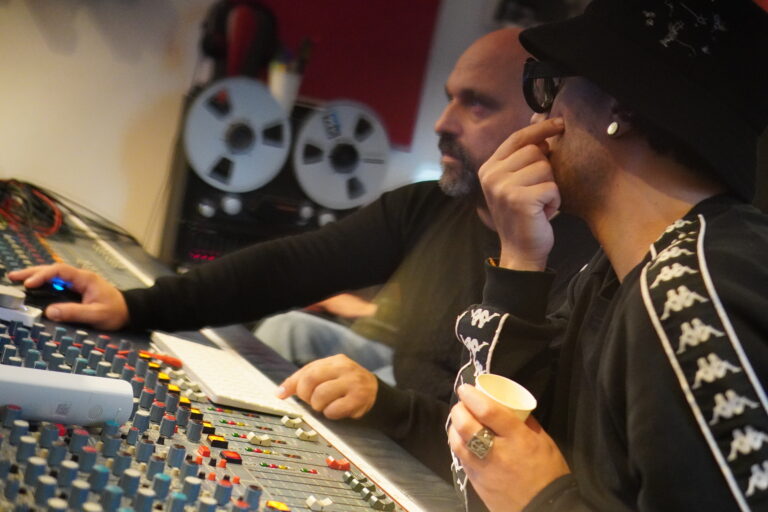
In the analog realm, when we purchased our first mixing consoles before eventually acquiring our Amek Angela, I always found a more intimate and musical space.
Mixing techniques are, all things considered, the same: we always have to manage levels, panning, equalization, dynamics, effects, and depth. However, the way we physically relate to the mix changes.
Of course, today even in an analog studio, digital is almost always part of the chain. A 51-channel mixer allows you to work simultaneously on a huge number of tracks, but in most cases, it is the DAW multitrack that sends the individual tracks to the console.
Working truly and completely in analog would instead imply using a multitrack tape recorder: a true step into the past that, even today, some bands and producers continue to choose precisely for the type of approach it demands.
In the studio, for example, we can create a song on 16 tracks working completely in the analog domain, without turning on Pro Tools. But, alas, very few musicians today are used to what it means to record knowing they do not have infinite editing possibilities.
We have grown accustomed to digital versatility, virtually endless overdubbing, editing, comping, and the ability to correct or modify almost anything. These are extraordinary possibilities that the analog world simply does not offer in the same way.
What really changes when mixing on a console?
Returning to the mix, personally I can say that mixing a track on an SSL, Neve, or, as in my case, an Amek console, represents a different experience.
There is a much more pronounced hands-on relationship. Put simply, you use your ears a lot more and your eyes, numbers, and screen a lot less.
Moving a fader, tweaking the equalizer, sending more signal to a bus, or physically pushing the level into an analog stage creates a different relationship with the sound.
Then there is the actual behavior of the electronics: transformers, operational amplifiers, equalization circuits, saturation, and non-linearity introduce harmonics and characteristics that contribute to a console’s personality. The EQ shapers, the dynamic behavior of the circuits, and the console’s headroom are elements that, once you get used to using them, can become an integral part of your way of mixing.
Mixing in analog, at least for me, means feeling even more a part of the artistic process. Not that digital doesn’t allow you to do this, of course, but the relationship is closer, more physical, and more human.
Even automation can become true gestures: fader movements are made by our hands and not simply drawn through a linear, exponential, or other type of curve. There are small imperfections, movements, and instinctive decisions that become part of the mix’s performance.
Analog or digital? I choose hybrid
I think mixing a song in analog can, in certain productions, push us a little further, delivering a massive and powerful result, yet at the same time musical and artistic.
This does not mean that an ITB mix cannot achieve equally professional results. It simply means that I personally much prefer working with analog.
The solution I find most effective is in fact a hybrid system: harnessing everything that digital can offer me while simultaneously using analog for what it does best.
Before hitting the console, I can use corrective plug-ins, editing, automation, filters, surgical fixes, and everything that would be much more complex or simply impractical to achieve in analog. Once it reaches the console, however, I prefer to entrust the desk with a major part of the sonic character, summing, punch, and general balance of the mix.
This is precisely, in my view, the great advantage of the hybrid workflow: not being forced to choose one technology over the other.
Digital and analog can coexist.
Digital gives us precision, speed, recall, and virtually infinite possibilities. Analog gives us physicality, character, and a different way of interacting with sound.
In the end, though, we always come back to the same point: it’s not the machine that makes a great mix. It’s the person using it, the decisions they make, and above all, the ability to listen.
I have simply found my way of working: using the best of digital, but letting the most instinctive part, the sound, the punch, and the overall character of the mix pass through the console.
And, definitely, I am happier this way.